ICM
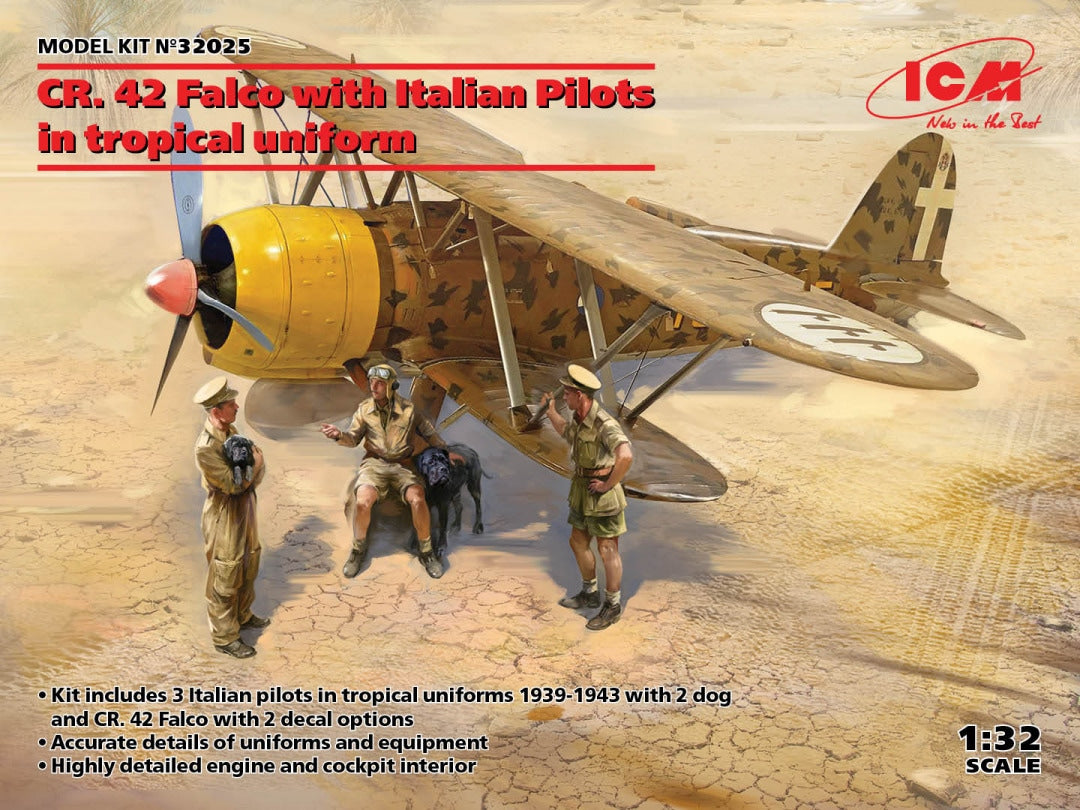
ICM 1/32nd scale CR.42 Falco with Italian pilots in tropical uniform
ICM 1/32nd scale CR.42 Falco with Italian pilots in tropical uniform
Couldn't load pickup availability
The Fiat CR.42 Falco (Falcon, plural: Falchi) is a single-seat sesquiplane fighter developed and produced by Italian aircraft manufacturer Fiat Aviazione. It served primarily in the Regia Aeronautica (Royal Italian Air Force) in the 1930s and during the Second World War.
The CR.42 was a development of Fiat’s earlier CR.32 fighter, powered by the more powerful supercharged Fiat A.74R1C.38 air-cooled radial engine and with improvements. It proved to be relatively agile in flight, attributed to its very low wing loading and a sometimes decisive tactical advantage. RAF Intelligence praised its exceptional manoeuvrability, further noting that "the plane was immensely strong", though it was technically outclassed by faster, more heavily armed monoplanes. While primarily used as a fighter, variants such as the CR.42CN night-fighter model, the CR.42AS ground-attack aircraft, and the CR.42B Biposto twin-seat trainer aircraft had other roles.
During May 1939, the CR.42 entered service with the Regia Aeronautica; it was the last of the Fiat biplane fighters to enter front line service. By 10 June 1940, when Italy entered the Second World War, roughly 300 had been delivered; these defended metropolitan areas and important military installations at first. By the end of 1940, the Falco had been involved in combat on various fronts, including the Battle of France, the Battle of Britain, Malta, North Africa, and Greece. By the end of the war, Italian CR.42s had been used on further fronts, including Iraq, the Eastern Front and the Italian mainland. Following the signing of the Italian armistice with the Allies on 8 September 1943, the type was relegated to use as a trainer by the Italian Co-Belligerent Air Force, while some Italian CR.42s were seized by the Germans and used by the Luftwaffe for ground-attack operations.
Share